

Last update: 01/21/2026
Spokeo and TruthFinder are on everyone’s lips, but which people search website should you trust? We’ve tested and compared both to help you decide. Read on to discover the differences in features, pricing, and accuracy.


Spokeo

TruthFinder
Searqle is the people search alternative you were looking for.
Try it for instant results!

Spokeo
TruthFinder
Spokeo was founded in 2006 as a service designed to aggregate data from various social media platforms. By 2010, the company transitioned into a full-fledged people search engine, expanding its capabilities. Today, Spokeo offers detailed reports by utilizing not just social media, but also public records (such as court and government documents), commercial databases, and mailing lists.
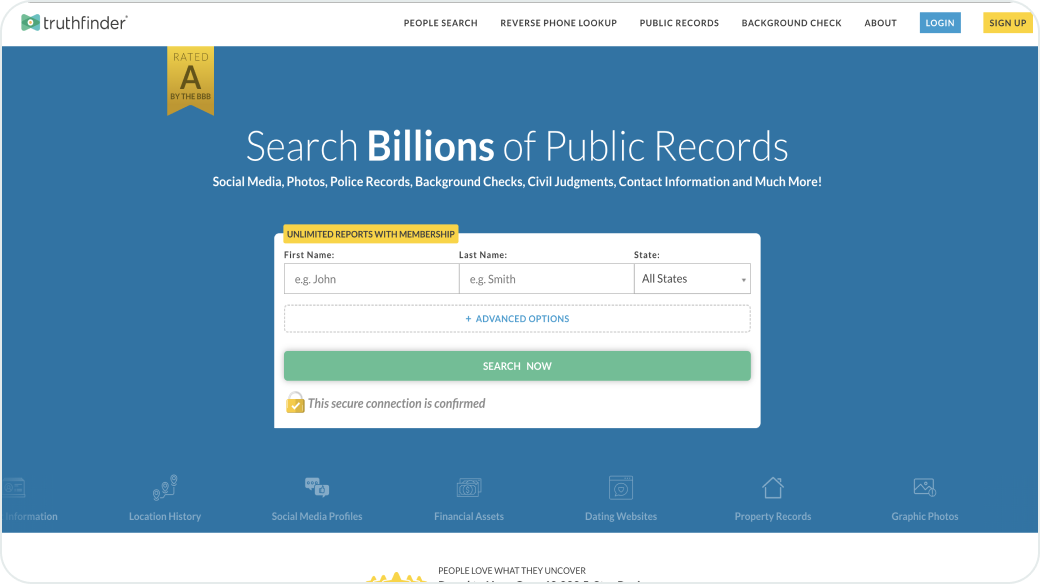
TruthFinder is an online public records search service founded in March 2015. While it can perform reverse checks (by phone number, name, or email) to provide basic information on an individual, it focuses on detailed background checks. TruthFinder is most suitable for users seeking detailed background information, including residential history, contact details, criminal records, social media profiles, and more.
Key Features
- People search by name, email, phone number, and address - Searches through social media and dating platforms - Detailed background reports - Alerts for data breaches
- In-depth background checks - Criminal, arrest, and traffic records - People search by name and known location - Reverse phone number lookup - Dark web scan
User Experience
Spokeo’s website is designed with ease of use in mind, featuring a simple layout and intuitive navigation. Users can easily find the search form and begin their inquiries. Full reports are typically available within minutes and are both comprehensive and user-friendly.
TruthFinder has a clean, well-organized website, making it easy to run background checks. After entering information into the search panel, it filters out irrelevant results by prompting users to specify details about the individual. Free results are superficial, while paid reports provide detailed information about residential history, family connections, education, career background, and more.
Pricing and Plans
Spokeo offers a 7-day trial for just $0.95, which then automatically converts to a monthly subscription priced at $29.95.
Subscription-based only. The monthly plan starts at around $28.05 (billed every two months). Basic search results are free.
Pros
- Affordable trial searches - Mobile app available - Confidential searches for privacy
- Detailed reports contain federal-, state-, and county-level data - The site provides basic details without any fees - Dark web scan helps users keep their sensitive data safe
Cons
- Slow customer support response times - Limited free information - Inconsistent data accuracy (some details may be incomplete)
- Searches take longer to complete - Single reports aren’t available for purchase - Operates in the U.S. only
Conclusion
Spokeo provides a broad range of data, though it may lack deep detail in certain areas. It’s ideal for users seeking basic information to supplement with additional research tools or sources.
Truthfinder is best suited for users looking for regular, in-depth checks who don’t mind spending some time on searches. Since it’s not a consumer agency or FRCA-compliant service, it’s best for personal use.
Got more questions about Spokeo and TruthFinder?
A quick people‑search tool built around contact details, social profiles, and basic public information. TruthFinder focuses on deeper background checks with more extensive criminal records, historic data, and dark‑web alerts. When we compare them, Spokeo delivers fast results for locating someone or confirming basic details, while TruthFinder produces fuller, more detailed reports. TruthFinder usually pulls in more sources and takes longer, but gives a broader picture of the person. So, if our goal is simple searching, Spokeo works best; if we want depth, TruthFinder is the better match
We’ve found that Spokeo is consistent for contact information and social‑network‑related data, while TruthFinder is normally more accurate for background‑check material. When we compare them side by side, Spokeo handles modern digital footprints well, and TruthFinder tends to capture more historical and criminal details. So it depends on what kind of accuracy matters most — surface‑level or deep‑level. TruthFinder usually wins when we need detailed results.
Both tools allow limited free previews, but full reports require a subscription. Spokeo sometimes shows a bit more initial information, while TruthFinder keeps nearly everything gated until payment. Neither platform gives enough free access for a complete search; their free features work more like a sample rather than a full product. So full use requires paying for either service.
Yes, both services are legitimate and collect public data. We consider them equally safe. However, because TruthFinder offers more in-depth records, it's important to use it responsibly and carefully. Like any tool of this kind, neither should be used for decisions that require legally compliant background checks. For regular personal lookups, both are safe choices.
We’ve seen that both platforms have straightforward cancellation processes. That said, Spokeo tends to feel a bit faster and more intuitive. TruthFinder isn’t complicated, but cancellation may include a couple of extra steps depending on the signup method. So overall, Spokeo is a bit easier to cancel.
Spokeo explicitly states it offers “the easiest opt-out policy among competitors” (though users still say removal can take time). For TruthFinder, the opt-out route exists (and you’ll find info), but given the depth of its database, you might see lingering references. If quick removal is your priority, you might give Spokeo an edge here.
Still deciding between the two?
Searqle is the alternative you’ve been missing. Find anyone by number, run background checks, and protect yourself from data leaks. Do it all on one reliable people search website.
START YOUR SEARCH


