
You have a photo of someone. You want to know who they are — their name, their social profiles, where else their face shows up online. That is what a facial recognition search engine is built for.
But most tools in this category don’t actually do facial recognition. They run a basic reverse image search: matching colours, backgrounds, and image files. A genuine facial recognition engine maps facial geometry — the distance between the eyes, the angle of the jaw, the shape of the nose bridge — and compares those measurements against an indexed database. The results are incomparable.
This guide covers the seven best facial recognition search engines in 2026, including both free and paid options. Each entry includes verified pricing, real features, and who it actually suits.
What Is a Facial Recognition Search Engine?
A facial recognition search engine uses AI to analyse the structural geometry of a face in an uploaded photo, then searches a database of indexed images for matches. This is different from reverse image search, which finds copies of the same image file or visually similar images based on colour and composition.
True face recognition can identify the same person across photos taken at different angles, under different lighting, or years apart. This makes it significantly more powerful for OSINT work — finding information about a specific person using only their photo. Common use cases include identity verification, catfish detection on dating platforms, background research, and tracking unauthorised use of your own images online.
The 7 Best Facial Recognition Search Engines in 2026
The tools below range from free reverse image utilities to full OSINT platforms that link a face to real-world identity data. Entries are ranked by depth of capability.
1. Searqle — Best for OSINT People Search by Photo

You upload a photo of someone and need more than a list of pages where their face appears. You need to know who they are — their name, phone number, email address, social profiles, and whether they have any data breach history associated with them. That is the gap Searqle fills.
Where most face search engines stop at the image match, Searqle chains the result to a full people search. Its Image Lookup feature runs facial recognition to find where a photo appears online, then cross-references those matches against a broader dataset of public records, social media profiles, email addresses, and contact information. The result is a profile, not just a list of URLs.
Key features:
- Upload a photo to find social media matches, original image sources, press and media mentions, and web forum appearances
- Cross-references face matches against public records — phone numbers, email addresses, usernames, location history
- Data breach signal detection — surfaces exposed accounts linked to the identified person
- 100% private search: the person in the photo is never notified
- Searches social media accounts and dating profiles, not just open web pages
- Clean interface — results return in seconds with no technical setup required
Pricing:
- $0.99 for a 3-day trial (full access)
- $24.90/month Basic
- $44.90/month Premium (deeper reports, higher usage limits)
Pros:
- One of the few tools that links face recognition results directly to contact data and public records — most competitors stop at the image match
- Fully private: searches are confidential, with no notification to the subject
- Covers social media, dating profiles, and forum mentions that pure reverse image tools miss
- Trial access for under $1 makes it easy to test before committing
Cons:
- Primarily US-focused for people data enrichment — face search works globally, but contact data depth is strongest for US-based individuals
- No free tier (trial requires payment)
Who it’s best for:
OSINT investigators, people trying to verify who they’re talking to online, journalists, HR professionals running pre-engagement checks, and anyone who needs to link a face to real-world identity data rather than just finding image matches.
Unlike tools such as PimEyes or FaceCheck.ID that return a map of where a face appears online, Searqle takes the next step — connecting facial recognition results to names, contact details, and social profiles, making it the stronger option when identification rather than image discovery is the goal.
2. PimEyes — Best for Privacy Monitoring
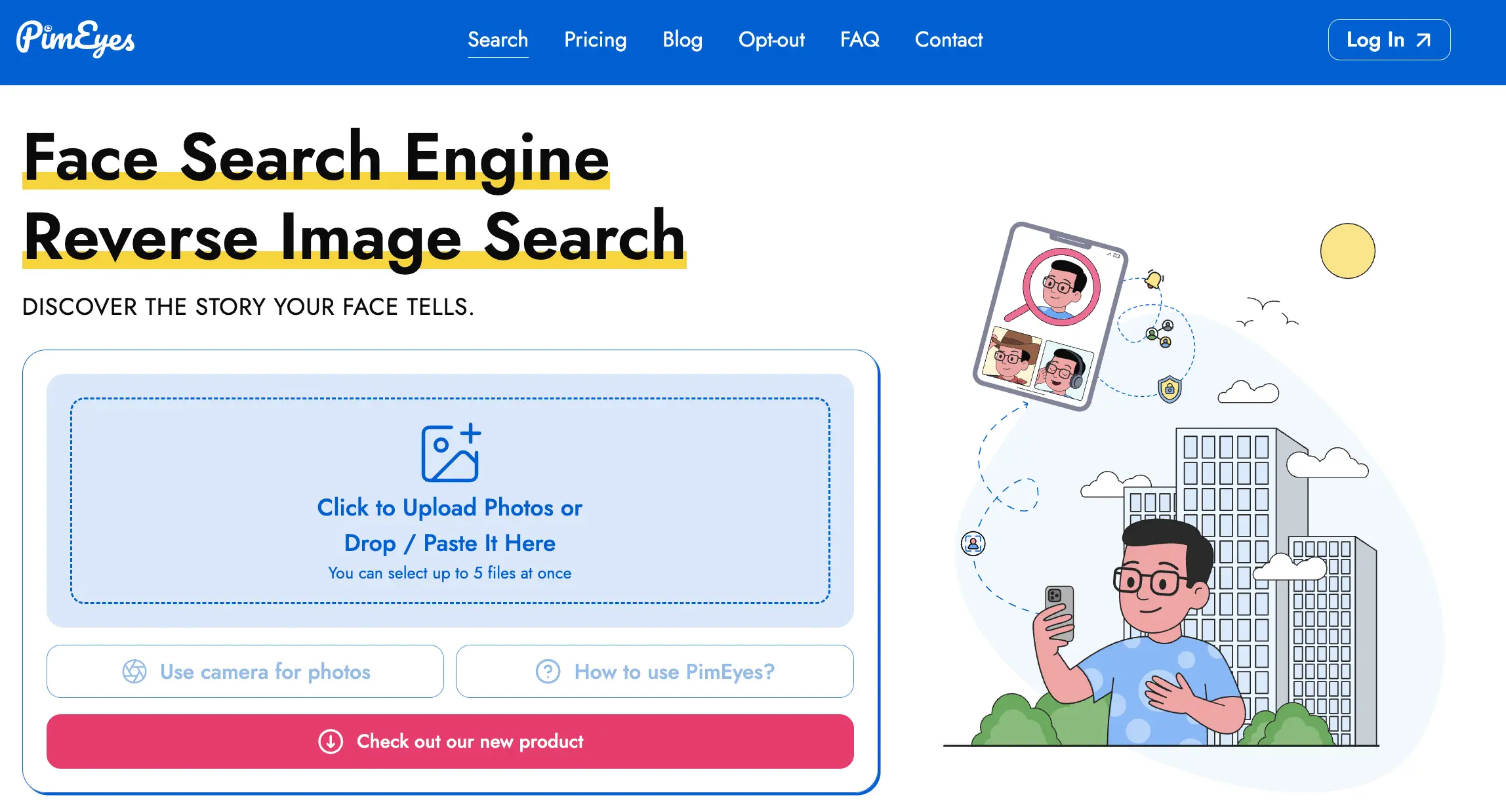
PimEyes scans an index of approximately 3.5 billion images to find where a specific face appears across the public web. It is one of the most well-known reverse face search tools and genuinely effective at finding images of yourself online.
Key features:
- Facial geometry matching across blogs, news sites, forums, and public web pages
- Auto-focus on a specific face in group photos
- Alerts when new images of your face are detected online (paid plans)
- DMCA and GDPR takedown request tool (up to 80 notices on higher tiers)
- Opt-out feature to prevent your photos from appearing in future searches
Pricing:
- Free tier (blurred previews only — no source links, functionally a teaser)
- Open Plus: $15.99/month (25 daily searches, full source URLs)
- PROtect: $29.99/month (monitoring + takedown features)
- Takedown-focused plans from $79.99/month
Pros:
- Genuinely large image index with strong open-web coverage
- Useful for photographers and public figures tracking image misuse
- Monitoring alerts add ongoing protection beyond one-off searches
Cons:
- Does not index social media — results miss major platforms where most photo misuse occurs
- Monthly subscription required for any useful access; no per-search option
Best for: Individuals who want to monitor where their own face appears online and take action on unauthorised use.
3. FaceCheck.ID — Best for Identity Verification
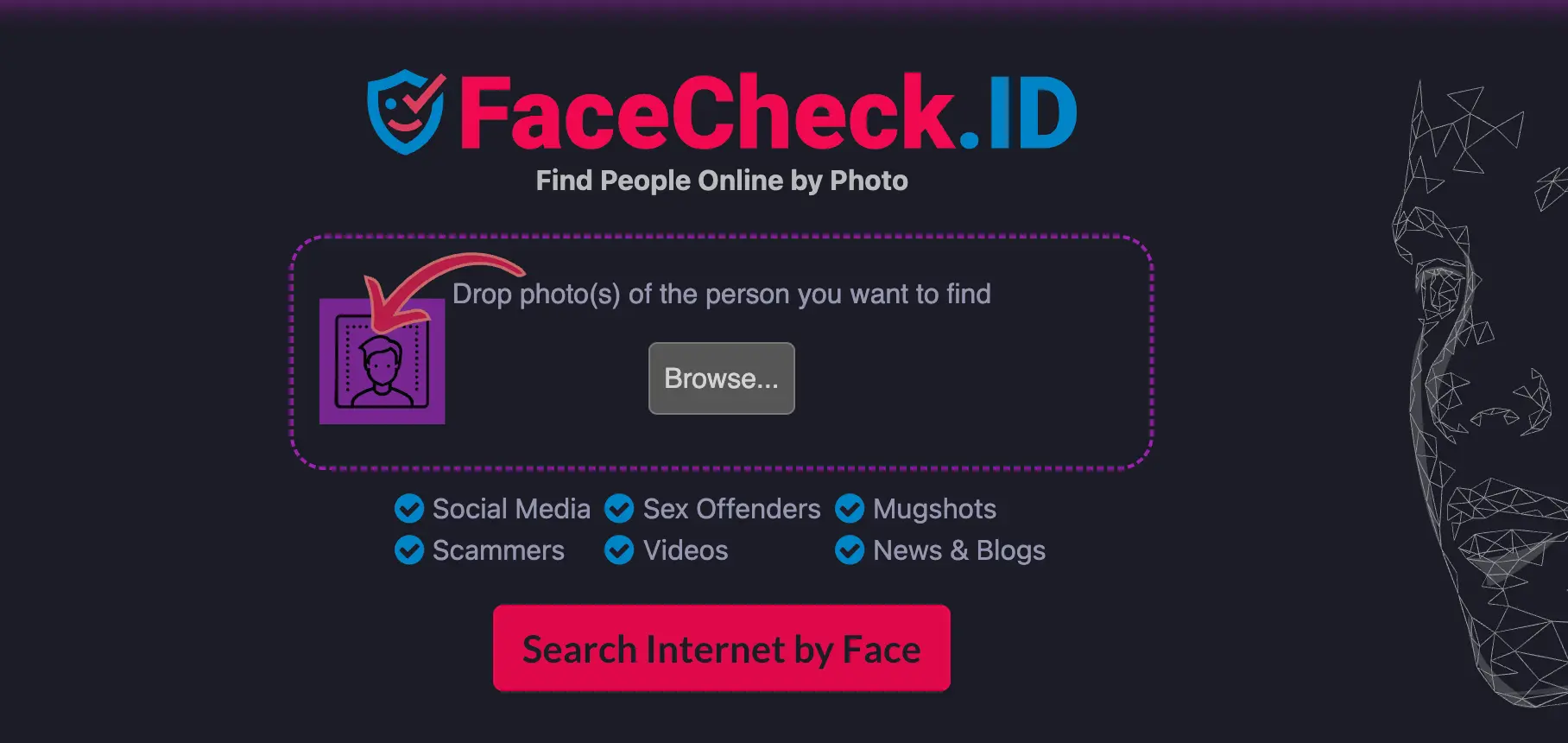
FaceCheck.ID uses facial geometry analysis to match uploaded photos against social media profiles, news archives, and mugshot databases. Its confidence scoring system — ranging from certain match (90–100) down to weak match (50–69) — helps users gauge how reliable a result is before acting on it.
Key features:
- Matches faces across social media, news sites, blogs, and mugshot databases
- Works on low-quality, angled, and partially obscured photos
- Confidence scoring with four tiers: Certain (90–100), Confident (83–89), Uncertain (70–82), Weak (50–69)
- Photo removal request process for individuals who want their images delisted
- Face Search API available for developers
Pricing:
Credit-based system. “Just a Peek”: $6 for 12 searches (credits expire in 2 days). “Rookie Sleuth”: $19 for 50 searches (14 days). “Private Eye”: $47 for 133 searches (2 months). Higher tiers up to $597 for 3,333 searches (1 year). Important: FaceCheck.ID switched to cryptocurrency-only payments in late 2024. Credit card, PayPal, and bank transfer are no longer accepted.
Pros:
- Per-search pricing suits occasional users who don’t need a monthly subscription
- Strong facial matching even on challenging photo conditions
- Confidence scoring adds transparency most competitors lack
Cons:
- Cryptocurrency-only payments create a real friction barrier for most users
- Cheapest credits expire in 2 days — you pay before knowing if the tool works for your specific search
- No monthly subscription option
Best for: Users doing occasional identity verification checks who are comfortable with crypto payments.
4. Social Catfish — Best for Catfish and Romance Scam Detection
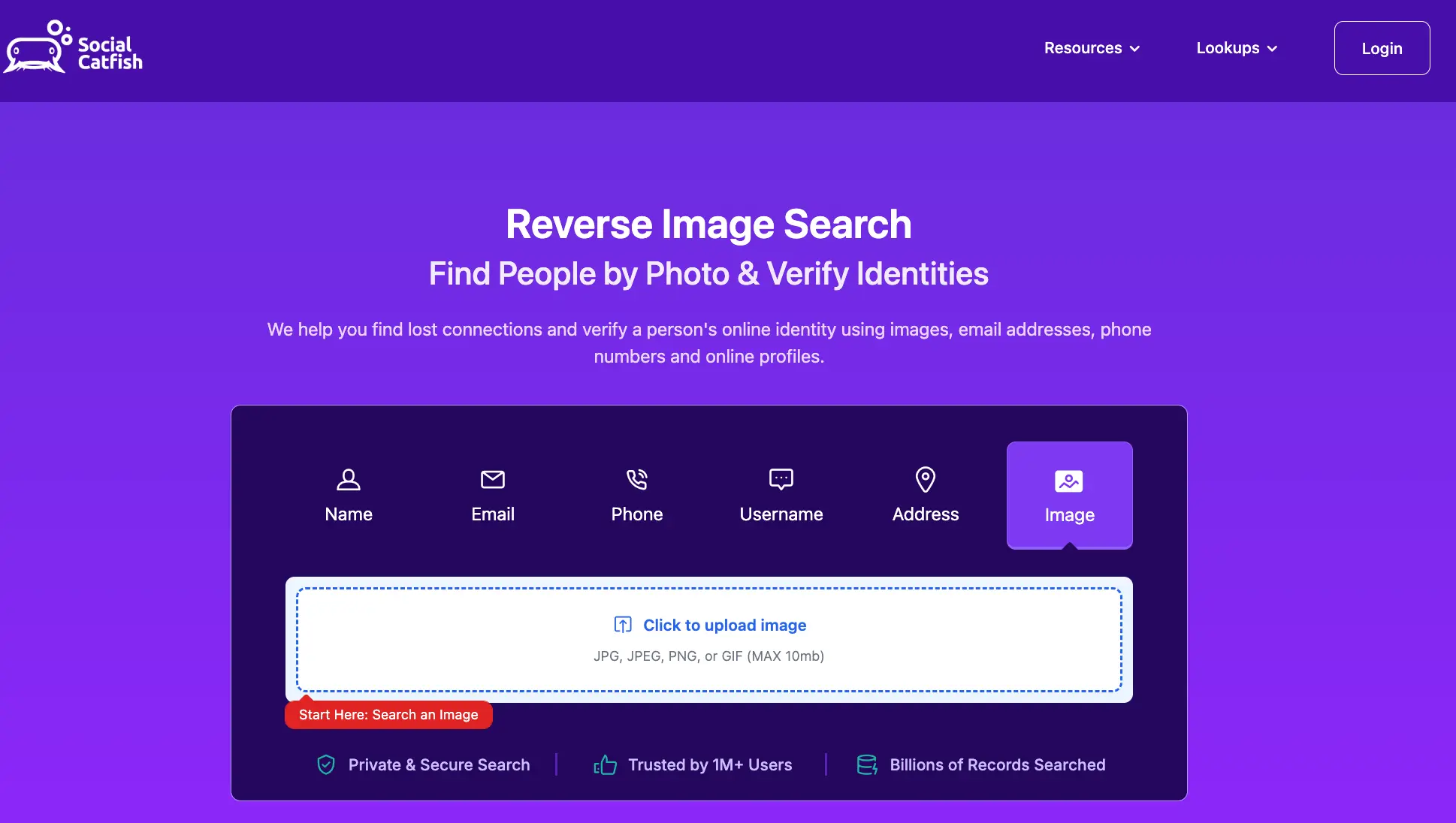
Social Catfish is built around uncovering fake online identities. Upload an image and it scans social media platforms, public records, dating sites, government databases, news articles, and professional records. Results are delivered as a detailed report including the person’s name, addresses, email addresses, and linked social profiles.
Key features:
- Reverse image search cross-referenced against dating platforms and social media
- Deep web scanning for optimum result coverage
- Detailed reports including biometric analysis, name, address, and email data
- Also supports search by name, email, phone number, and username
Pricing:
- No free plan. 3-day trial: $6.87.
- Social search subscription: $27.95/month (100 social searches).
- Image search and reverse image search: $28.97/month (unlimited image searches).
Pros:
- Strong coverage of dating platforms — particularly effective for romance scam and catfish investigations
- Detailed report format suited to building a complete picture of an identity
- Searches deep web sources that standard tools skip
Cons:
- No free tier or free trial without payment
- Image processing time is slower than most competitors
Best for: People using online dating platforms who want to verify whether a profile is genuine before meeting or sending money.
5. Lenso.ai — Best Free Option for Quick Face Searches

Lenso.ai is a free-to-start reverse image search platform with dedicated face search functionality. It analyses facial features to find similar faces across a large indexed database, with filter options to refine results by type (people, places, duplicates, related images).
Key features:
- Face search, duplicate image detection, and location-based image search in one platform
- Filter results by category to narrow face-specific matches
- Facial match alerts available — monitoring when your face appears online
- Accessible to non-technical users with a simple upload interface
Pricing:
- Free plan available (no credit card required for basic searches).
- Paid plans with expanded access and higher result volumes also available.
Pros:
- Genuinely free to start — no credit card required for basic searches
- Fast results with a clean, easy-to-navigate interface
- Multi-purpose: handles face search, place recognition, and duplicate detection
Cons:
- Limited social media results compared to dedicated people-search tools
- Struggles with photos that have filters or heavy edits applied
- Index can surface older or outdated matches
Best for: Casual users who need a quick, no-cost first check before deciding whether a paid tool is warranted.
6. Yandex Images — Best for Eastern European and CIS Coverage
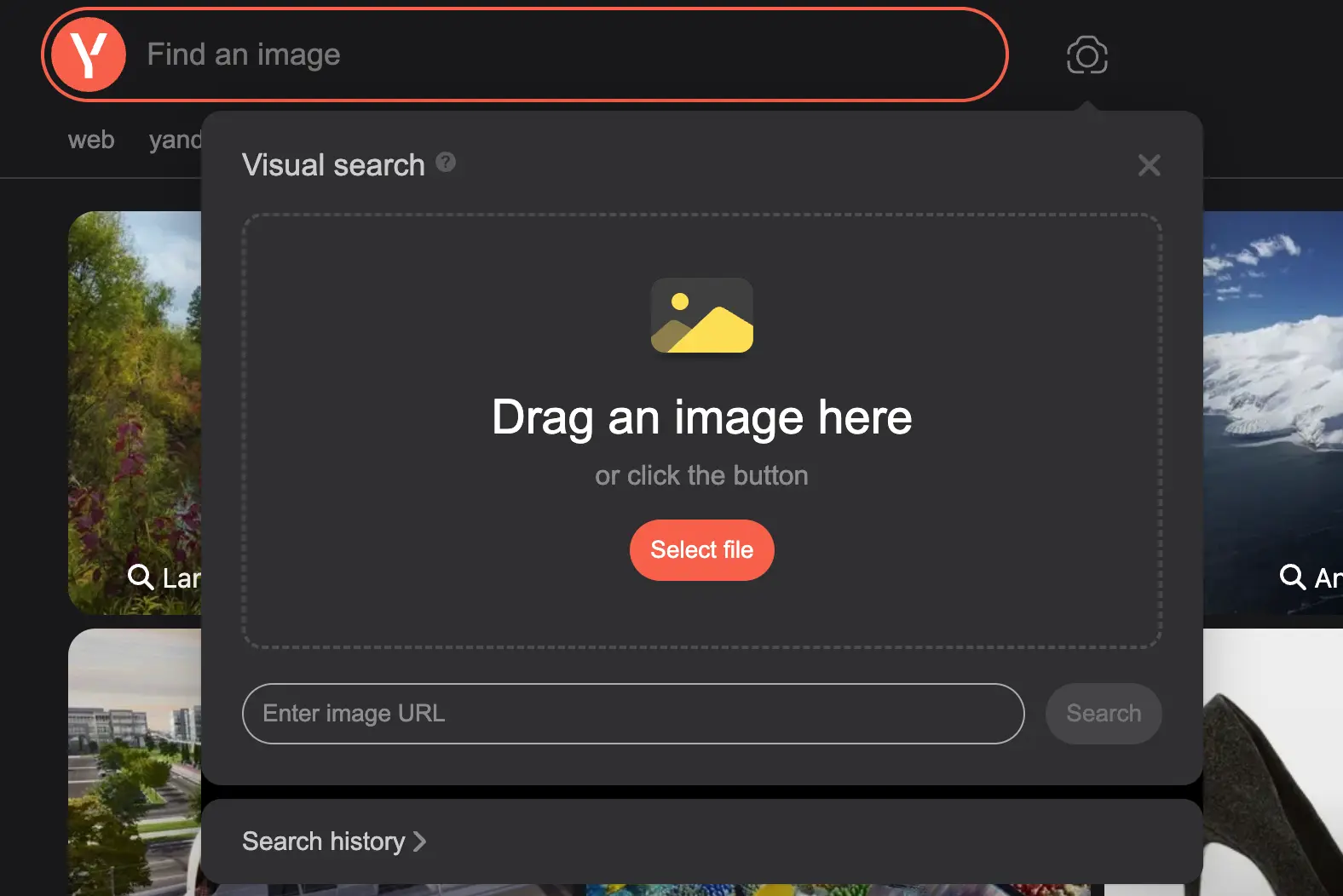
Yandex is Russia’s dominant search engine, and its image search has built a reputation among OSINT researchers for unusually strong face-matching results — particularly for individuals with a presence on Russian-language social networks like VK or OK.ru, which most Western tools do not index.
Key features:
- Free to use with no account required
- Broad open-web image index with above-average face-matching for CIS-region content
- No database fees or search limits
Pricing: Free.
Pros:
- Only major free tool with meaningful coverage of Russian-language and Eastern European social networks
- No registration, no limits, no payment
- Useful as a supplementary check after other tools
Cons:
- Results are inconsistent — the same photo can return strong matches one day and nothing the next
- Not true facial recognition: blends face similarity with general image matching
- No confidence scoring, no source labelling, no reporting tools
Best for: OSINT researchers working on subjects with an Eastern European or CIS online presence, as a complementary search alongside a dedicated face search engine.
7. Google Images — Best Free General-Purpose Tool
Google’s reverse image search via Google Lens is the most widely accessible entry point for image-based searches. It detects faces, objects, scenes, and landmarks, and integrates with Google Photos for seamless cross-device searching.
Key features:
- Free with no account required
- Detects faces, objects, scenes, and text within images
- Integrated with Google Lens for in-browser and mobile searches
- Broad web coverage including news, blogs, and indexed social content
Pricing: Free.
Pros:
- No cost, no registration, immediately accessible
- Strong for identifying celebrities, public figures, and widely published images
- Works reliably on any device via browser or Google Lens app
Cons:
- Does not perform true facial geometry mapping — finds visually similar images rather than identifying the same face across different photos
- Ineffective for finding a private individual across multiple photos
Best for: Quick checks on whether an image has been reposted, identifying public figures, or verifying whether a stock photo is being used as a fake profile picture.
Facial Recognition Search Engine Comparison
The table below maps each tool against six criteria that matter most to OSINT and identity verification users.
| Feature | Searqle | PimEyes | FaceCheck.ID | Social Catfish | Lenso.ai | Yandex | Google Images |
|---|---|---|---|---|---|---|---|
| True Facial Recognition | Yes | Yes | Yes | Yes | Yes | Partial | No |
| OSINT Data Enrichment | Yes | No | No | Partial | No | No | No |
| Free Plan | Trial $0.99 | Blurred preview | Blurred preview | Trial $6.87 | Yes | Yes | Yes |
| Social Media Coverage | Yes | No | Yes | Yes | Limited | Partial | Limited |
| Dating Profile Search | Yes | No | No | Yes | No | No | No |
| Starting Price | $0.99 trial | $15.99/mo | $6 (12 searches) | $27.95/mo | Free | Free | Free |
How to Choose a Facial Recognition Search Engine
Four factors determine which tool fits your situation.
1. Do you need identification, or just image discovery?
Most face search engines tell you where a photo appears online. If you need to identify who the person actually is — name, contact details, social accounts — you need a tool that enriches face results with people search data. Searqle does this; PimEyes and FaceCheck.ID do not.
2. How often will you search?
Monthly subscriptions (PimEyes, Social Catfish) only make sense if you run searches regularly. Occasional users are better served by per-search pricing (FaceCheck.ID) or a short-term trial (Searqle).
3. Are you comfortable with crypto payments?
FaceCheck.ID moved to cryptocurrency-only billing in late 2024. If you prefer standard payment methods, this tool is not a practical option.
4. Where is your subject based?
For US-based individuals, Searqle offers the deepest public records enrichment. For Eastern European subjects with CIS social network presence, Yandex is a valuable supplementary tool.
Quick routing guide:
- Casual user, one quick check → Lenso.ai or Google Images
- Identify who a person is from a photo → Searqle
- Monitor your own photos online → PimEyes
- Dating safety / catfish verification → Social Catfish or Searqle
- OSINT research → Searqle + Yandex as a supplementary check
- Occasional identity verification, crypto-friendly → FaceCheck.ID
Not sure how the process works before picking a tool? Read how to search by face for a step-by-step overview.
Frequently Asked Questions
For identifying a person and linking their face to real-world data such as phone numbers, email addresses, and social profiles, Searqle is the strongest option in 2026. For pure image discovery across the open web, PimEyes indexes the largest database at approximately 3.5 billion images. FaceCheck.ID provides the most granular confidence scoring.
Lenso.ai and Yandex Images offer genuine free access with no credit card required. Google Images is free but does not perform true facial recognition. PimEyes and FaceCheck.ID offer free tiers, but results are blurred until you pay — making them teaser previews rather than usable free tools.
In most jurisdictions, running a reverse face search on publicly available images for personal safety, identity verification, or OSINT research is legal. It is not legal to use these tools for stalking, harassment, unauthorised surveillance, or employment and credit decisions in the US under FCRA. Always check the terms of service of the tool you use and the laws applicable in your country before conducting searches on third parties.


